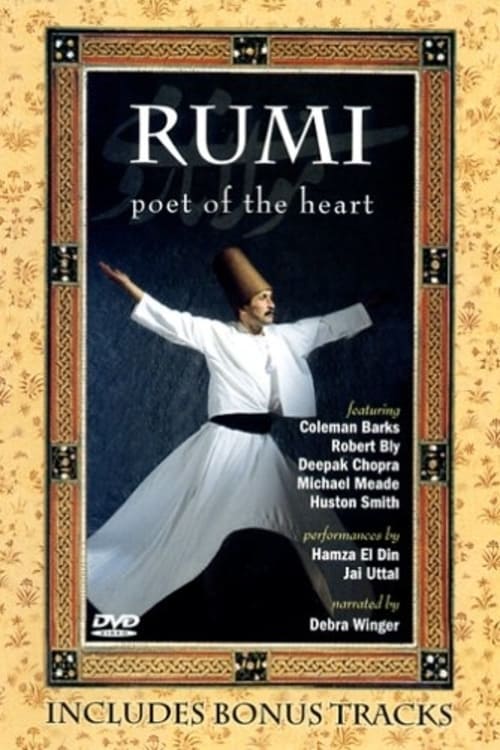
Rumi: Poet of the Heart (1998)
In 1244, Jelaluddin Rumi, a Sufi scholar in Konya, Turkey, met an itinerant dervish, Shams of Tabriz. A powerful friendship ensued. When Shams died, the grieving Rumi gripped a pole in his garden, and turning round it, began reciting imagistic poetry about inner life and love of God. After Rumi's death, his son founded the Mevlevi Sufi order, the whirling dervishes. Lovers of Rumi's poems comment on their power and meaning, including religious historian Huston Smith, writer Simone Fattal, poet Robery Bly, and Coleman Barks, who reworks literal translations of Rumi into poetic English. Musicians accompany Barks and Bly as they recite their versions of several of Rumi's ecstatic poems.
Movie Info
In 1244, Jelaluddin Rumi, a Sufi scholar in Konya, Turkey, met an itinerant dervish, Shams of Tabriz. A powerful friendship ensued. When Shams died, the grieving Rumi gripped a pole in his garden, and turning round it, began reciting imagistic poetry about inner life and love of God. After Rumi's death, his son founded the Mevlevi Sufi order, the whirling dervishes. Lovers of Rumi's poems comment on their power and meaning, including religious historian Huston Smith, writer Simone Fattal, poet Robery Bly, and Coleman Barks, who reworks literal translations of Rumi into poetic English. Musicians accompany Barks and Bly as they recite their versions of several of Rumi's ecstatic poems.
Similar Movies

A Farra do Circo
2013

Armando Rojas Guardia: El esplendor y la espera
2005
No Regret
1993

The Hermetic Jung
2016

The Language of Trees
1983

Hello My Dear
2021

Song of Myself (Section 51)
Phenomenon
1977

Tuesdays: (A Poem!).
2024
Ashes
1975

The Beach - San Francisco’s North Beach in the 50s
1995
This Beggar's Description
2006
Isla Negra: Neruda y el mar
1990
Merton: A Film Biography
1984

Morena
2019
I Set Out
2015

Albert Camus, la tragédie du bonheur
1999

The Music of Life
2009

Cacaso
2016

Jo
2025